
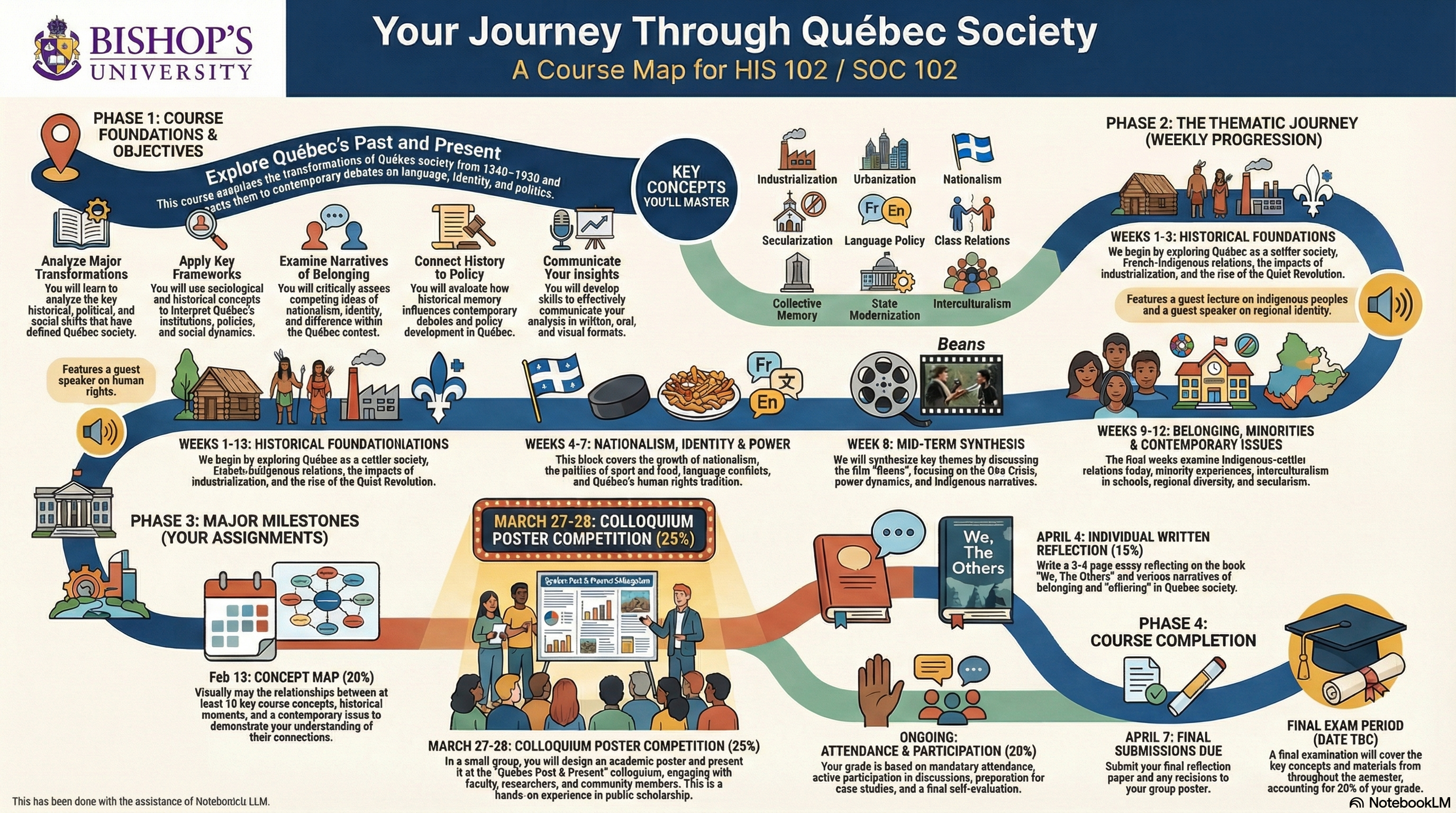
This course introduces students to the historical, political, and social transformations that have shaped Québec society from the mid-nineteenth century to the early twentieth century, while consistently linking these dynamics to contemporary debates. It examines the issues Quebecers themselves consider most critical to their collective life and future, including the preservation of the French language, cultural protection and gender equality, the management of class and ethnic relations, nationhood and memory, and Québec’s place within Canada and on the international stage. Key topics include French–Indigenous relations, religion and political secularism, the evolution of a market-oriented economy, conflicts between French and English Canada, successive waves of industrialization and urbanization, as well as cultural development, nationalism(s), language politics, interculturalism, feminism, immigration, and minority relations.
Although many societies confront similar challenges in an era of globalization, context remains central to understanding how Québec functions as a distinct society. Québec’s predominantly French language and culture, the volatility of debates surrounding its national status, and the deep entanglement of its past with its ever-changing present make its social dynamics both complex and analytically rich. Through the examination of identity work, social relationships, institutions, and lived experiences, the course engages with both current events and long-standing collective issues such as belonging, inequality, policy development, and relations between majority and minority groups, including English-speaking Quebecers and Indigenous peoples. Throughout the semester, students will engage with key sociological frameworks and concepts through lectures, discussions, and individual visual and written work, developing an informed understanding of the directions Québec society is taking today and the trajectories shaping its future.
Although many societies confront similar challenges in an era of globalization, context remains central to understanding how Québec functions as a distinct society. Québec’s predominantly French language and culture, the volatility of debates surrounding its national status, and the deep entanglement of its past with its ever-changing present make its social dynamics both complex and analytically rich. Through the examination of identity work, social relationships, institutions, and lived experiences, the course engages with both current events and long-standing collective issues such as belonging, inequality, policy development, and relations between majority and minority groups, including English-speaking Quebecers and Indigenous peoples. Throughout the semester, students will engage with key sociological frameworks and concepts through lectures, discussions, and individual visual and written work, developing an informed understanding of the directions Québec society is taking today and the trajectories shaping its future.
- Teacher: Diego Osorio
- Teacher: David Webster