
“When she meets people at parties and identifies herself, they sometimes say condescendingly, ‘A librarian, how nice. Tell me, what is it like to be a librarian?’ She replies, ‘Essentially, it is all about money and power.’”
– Robert Darnton, The Case for Books: Past, Present, and Future
Michel Foucault observes in The Archaeology of Knowledge and the Discourse on Language that one’s literary contributions are provisional, dependent upon the discourses of the period that inform one’s texts; he argues that archives are not “the sum of all texts that a culture has kept upon its person as documents attesting to its own past,” but rather “the law of what can be said, the system that governs the appearance of statements as unique events” (1972, 128-9). An archive defines “at the outset the system of its enunciability” (129). What is included within a repository—and the shape of the repository itself—determines and limits potential enunciations of personhood. A woman writer could only uneasily make claims to authorship, if discourses of a given period or the “law of what can be said” would not recognize her as such.
This course focuses on women writers’ archives and literary exchanges in Canada and characterizes the socio-political and historical contexts that undergird them; it explores what incarnations these archives and literary papers may assume at different epochs and explore how socio-political archival representations of women evolve over time in response to structures of power. Exploring critical work of the last twenty years that addresses archival theory, we will investigate how women’s archives may be seen as an extension of their literary lives and characterized multiply—as feminist, queer, activist—and therefore might be called upon to generate collective action; to go against a patriarchal, sexist, racist, or imperial grain; or to develop networks and alliances that supersede political or national borders. Using several different female writers (their books and/or their archival materials) and working with the archives at the Eastern Townships Resource Centre, among others, we will read how women’s literary lives were forged, contested, and negotiated. We will consider how race, gender, and sexual orientation intersect with, affect, and/or supersede national interests and claims to nation, through the very means by which women’s archives (institutional and other) are forged and preserved over time, and by the materials that are selected for preservation therein.
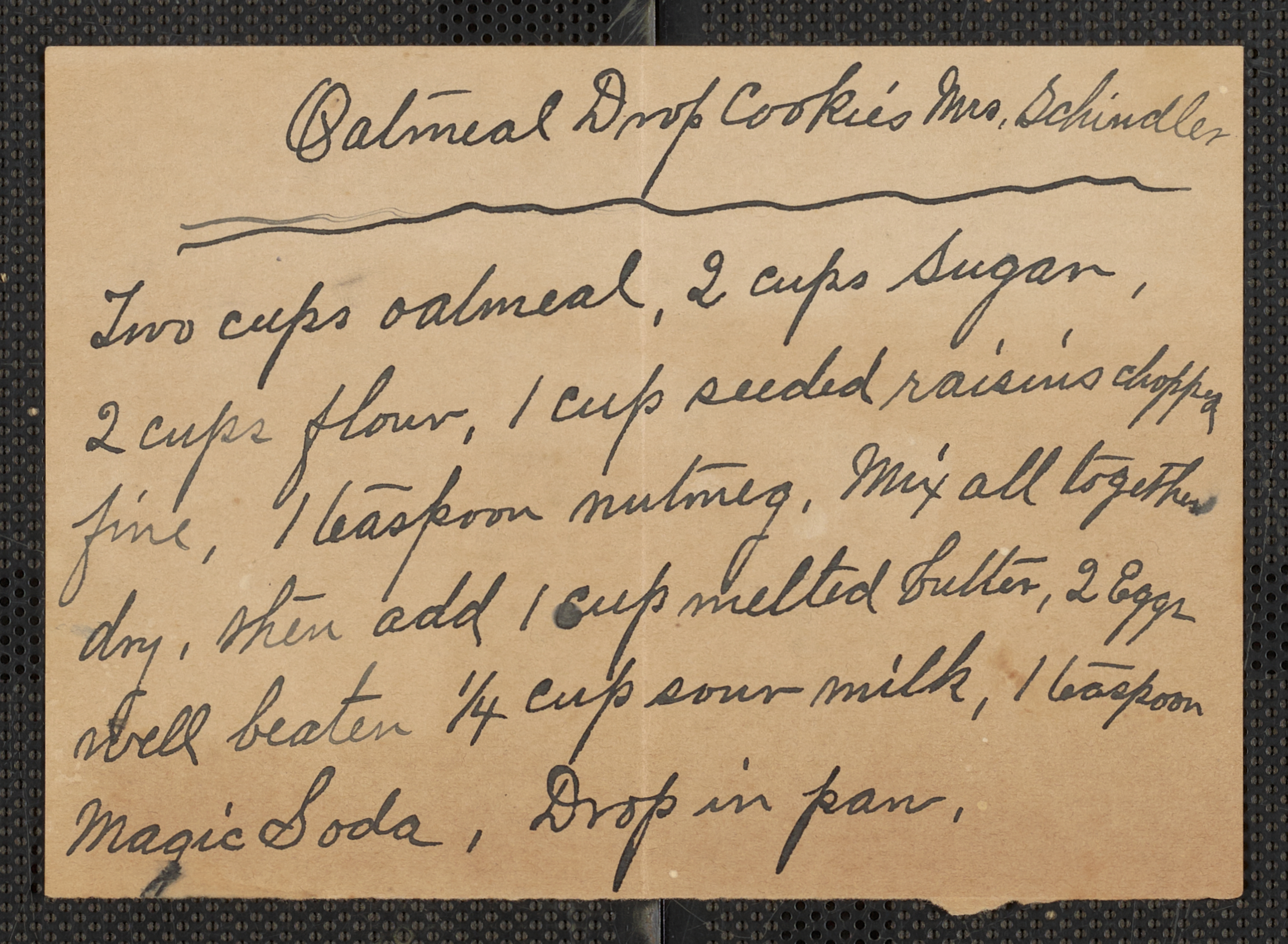
Course Image: Mrs Schindler's Oatmeal Drop Cookies, Smithsonian, 2009.2033.1.208.6
– Robert Darnton, The Case for Books: Past, Present, and Future
Michel Foucault observes in The Archaeology of Knowledge and the Discourse on Language that one’s literary contributions are provisional, dependent upon the discourses of the period that inform one’s texts; he argues that archives are not “the sum of all texts that a culture has kept upon its person as documents attesting to its own past,” but rather “the law of what can be said, the system that governs the appearance of statements as unique events” (1972, 128-9). An archive defines “at the outset the system of its enunciability” (129). What is included within a repository—and the shape of the repository itself—determines and limits potential enunciations of personhood. A woman writer could only uneasily make claims to authorship, if discourses of a given period or the “law of what can be said” would not recognize her as such.
This course focuses on women writers’ archives and literary exchanges in Canada and characterizes the socio-political and historical contexts that undergird them; it explores what incarnations these archives and literary papers may assume at different epochs and explore how socio-political archival representations of women evolve over time in response to structures of power. Exploring critical work of the last twenty years that addresses archival theory, we will investigate how women’s archives may be seen as an extension of their literary lives and characterized multiply—as feminist, queer, activist—and therefore might be called upon to generate collective action; to go against a patriarchal, sexist, racist, or imperial grain; or to develop networks and alliances that supersede political or national borders. Using several different female writers (their books and/or their archival materials) and working with the archives at the Eastern Townships Resource Centre, among others, we will read how women’s literary lives were forged, contested, and negotiated. We will consider how race, gender, and sexual orientation intersect with, affect, and/or supersede national interests and claims to nation, through the very means by which women’s archives (institutional and other) are forged and preserved over time, and by the materials that are selected for preservation therein.
Course Image: Mrs Schindler's Oatmeal Drop Cookies, Smithsonian, 2009.2033.1.208.6
- Teacher: Gregory Brophy
- Teacher: Jean Manore
- Teacher: Linda Morra